Refuse Service, City of Berkeley, California 1949
Since 1924, the City of Berkeley has reclaimed more than 100 acres of tide lands which are now being utilized for business and industrial purposes. Berkeley is doubly fortunate in its disposal facilities. Not only is the amount of waterfront in tide lands almost unlimited (7.5 square miles of the City of Berkeley lies under water) but the location is such that it is isolated from the residential and business areas by an industrial belt along the Bay front. -read more-
-
Street sweeping is done entirely by hand, but it is anticipated that mechanical power sweeping equipment will be purchased in 'the near future. There are 22 men actively engaged in sweeping the streets. -read more-
Street Maintenance in the City of Berkeley, 1927
In Berkeley, Calif., the Department of Public Works has developed a system of maintaining cost data that has led to concrete results, especially in regard to street maintenance. -read more-
|
The “Area E” residential parking district RPP has been likened to going theater where you buy a ticket for the show only to be turned away at the door and told there is no more seating left. This is the current parking reality around the Trader Joe’s store and the North Berkeley Senior Center areas (southeast corner of Area E). read more- |
Northwest Berkeley Body Burden Study (Part of the East Bay Body Burden Project) What makes the Northwest Berkeley body burden study unique is its focus on a narrow geographic test area and that only two metals in the blood samples will be screened. A comprehensive screening of the population will ultimately provide a clearer picture of actual community exposure to the airborne nickel and manganese. -read more-
|
West Berkeley Community AIR Monitoring PROJECT
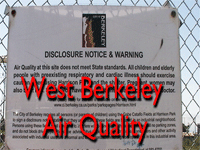
"The San Francisco Bay Area Air Quality Management District staff has reviewed and affirmed the data and the Standard Operating Procedures. The monitoring equipment used, while not a federal reference method, is widely used in the environmental field because it is credible and generates reliable data, though it is not employed by the District in its ambient air monitoring network." March 13, 2008
|
Strawberry Canyon Watershed
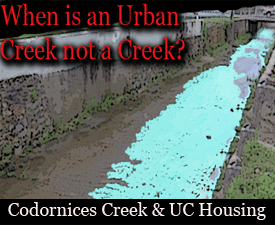
Some in Berkeley may think that an urban creek is little
more than a concrete trench and that creek restoration
is accomplished merely by planting a few trees along the banks. There
are likely others who would say that, the only way to return any of
the city's creeks to their natural state is to reintroduce grizzly bears
to Berkeley. ...-read more- |
Cancer Risk in West Berkeley
For decades, the stench from airborne chemicals emitted by Pacific Steel Casting has been allowed to pollute the air downwind from its foundries with virtual impunity. Environmental changes have come slowly to this part of the city. While other industrial polluters are much smaller, or have moved away in response to the growing residential population in this district, PSC’s operations have been allowed to expand. -more-
|
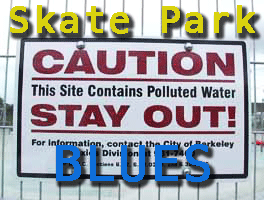
Berkeley’s Skate Park: Backslide on the Chrome-6
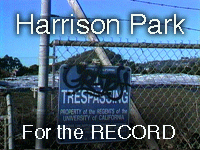
From its opening days in 2003 when the complex was abruptly closed because of toxic groundwater seepage, Harrison skate park has been a gnarly ride for Berkeley. Now it appears to be in an irreversible backslide and headed for a wipeout. -read more-
|
Berkeley Opts Out of Clean Water
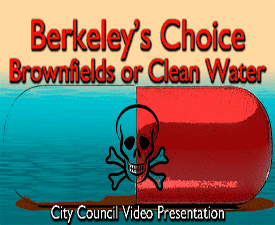
“City of Berkeley, the water is murky” has become the latest rap on the city’s crumbling storm drain infrastructure. For nearly two decades, Berkeley’s Clean Water efforts in controlling surface water pollution have amounted to little more than a “greenwash” of meaningless phrases such as “Save the Bay”. -read more-
|
City of Berkeley Sewer System History
Most early sewers were designed to carry both stormwater and sanitary sewer flows in the same pipeline. Sewage was not treated but discharged directly into San Francisco Bay from outfalls at Potter Street, University Avenue, Virginia Street, Gilman Street, and Marin Avenue at Fleming Point. -read more-
|
|
Berkeley Citizen © 2003-2010 All Rights Reserved |